Who Really Owns the AI Rebound
16 November 2026
What the rally in mid-sized suppliers reveals about global equity diversification.
In our last piece, we argued that the AI sell-off had opened the door to a rebound. Investors were right to ask what the technology giants would earn on their spending. The sell-off also caught suppliers still reporting strong demand. When their shares rebounded, the scale of the move raised a question for global equity investors. How much of that recovery did their portfolios actually capture?
Where the rebound showed up
In the week to 13 November, the S&P 500 rose 2.5% and an ETF tracking the S&P MidCap 400 gained 2.3%. The recovery was much sharper in three AI suppliers. Astera Labs rose 16.3%, Coherent 13.1% and Lumentum 10.8%. In our earlier research, the median stock in a selected group of 14 mid-sized AI companies had fallen almost 30% over a month. Astera and Coherent had reported quarterly revenue growth of 154% and 50% year on year, respectively.
What the rebound did to valuations
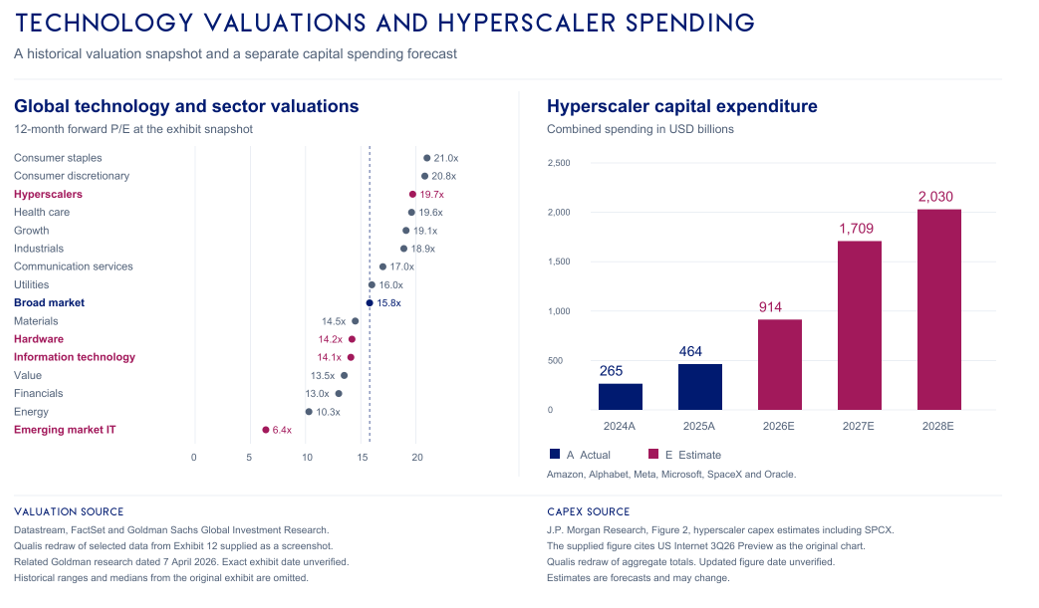
The rebound raised the price of participating in the AI build-out. Over the week, Astera rose from roughly 29 to 33 times expected fiscal-year earnings, Coherent from 19 to 22 times and Lumentum from 25 to 28 times. The J.P. Morgan exhibit projects combined spending by six companies rising from $914bn in 2026 to $1.71tn in 2027. For suppliers, the test is how much of that spending becomes durable profit. For investors, it is how much of that profit the share price already assumes.
When an index weight barely registers
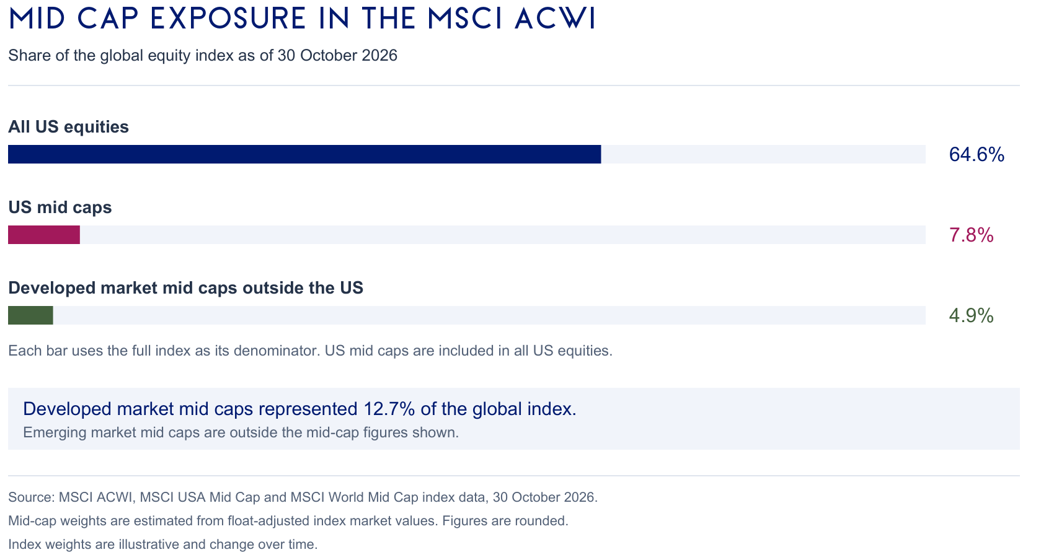
At the end of October, US equities made up 64.6% of MSCI ACWI. US mid-caps accounted for 7.8% of the full index and developed-market mid-caps outside the US for another 4.9%. Each figure covers an entire segment. Individual AI suppliers can carry so little weight that even a sharp move in their shares barely registers in a global portfolio. A dedicated allocation gives investors more control over how much exposure they take.
Diversification beyond the US
An investment in the AI build-out can take several forms. The technology giants need customers to pay for AI services. Suppliers can earn revenue as customers install capacity and buy optics, power, cooling and test equipment. Holding several suppliers spreads company-specific risk, while their exposure to the same spending cycle remains. Diversifying the sources of return also means owning businesses with different drivers of earnings.
The recovery reached mid-caps outside the US that week. Japan’s TOPIX Mid 400 rose 6.7%, an ETF tracking MSCI Europe Mid Cap gained 2.9% in euros and the FTSE 250 rose 1.2% in sterling. The opportunity abroad includes specialists such as Japan’s Santec, which makes optical test equipment. It also includes businesses whose earnings depend more on local demand and investment. Those are two different reasons for a global portfolio to look beyond the US.
How we put that into practice at Qualis
MGTS Qualis Growth has a dedicated allocation to Guinness Global Quality Mid Cap. The underlying fund had $26.2m in assets on 9 November. A screen that starts with fund size could easily pass it over. We start with what the manager owns and what those businesses add to Qualis Growth. Guinness gives us exposure to Vertiv in data-centre power and cooling, Entegris in semiconductor materials and Teradyne in test equipment. Fund size matters when we decide how much we can allocate.
For investors comparing global equity funds, ask what would drive returns if suppliers led the next leg of the AI rally. At Qualis, we can point to the allocation, the companies underneath it and how they fit with the rest of the portfolio. Selected suppliers look well positioned where their products address capacity constraints and demand can translate into cash flow. After the rebound, the price we pay still matters.
References to Guinness and other individual funds and companies illustrate portfolio construction and do not constitute a recommendation to buy, sell or hold any investment. Holdings and weights may change.
Capital is at risk. The value of investments and any income can fall as well as rise, and investors may get back less than they invest. Diversification does not eliminate the risk of loss. Past performance is not a reliable indicator of future results.
Sources and data basis
Market figures are local-currency price changes from 6 to 13 November 2026. Sources include AP market close · US mid-cap ETF · Astera price · Coherent price · Lumentum price · Japan · Europe · UK.
Company results and fund data from Astera Labs · Coherent · Santec · Guinness · Qualis research and Morningstar holdings.
Index weights calculated from MSCI ACWI · MSCI USA Mid Cap · MSCI World Mid Cap.
Supplier P/Es use Morningstar’s point-in-time prices and consensus earnings for each company’s current fiscal year on 6 and 13 November 2026. Astera Labs · Coherent · Lumentum.
The Goldman Sachs exhibit uses next-12-month earnings. Its observation date and the date of the updated J.P. Morgan figure are unverified. Related public research from Goldman Sachs and J.P. Morgan Asset Management.