Rates are making the headlines. Credit may be telling the bigger story.
6 October 2026
Over the past week, financial-market attention has quite rightly been focused on government bond yields.
The moves have been extreme. Long-dated sovereign yields have pushed materially higher, the UK long end has again come under pressure, US Treasury yields remain elevated, and in Europe the widening gap between French and German government borrowing costs has become an increasingly important signal in its own right.
Those are the headlines. But we would argue that the more important question for investors now is not simply how high government bond yields can go. It is whether the stress in rates is beginning to transmit into credit.
That matters because rates tell us the general cost of money. Credit tells us how the market is starting to judge the ability of borrowers to cope with it.
And over the past week, credit has started to demand more attention.
A clear deterioration down the quality spectrum
Looking at spread moves over the week, the pattern is telling.
- US investment grade widened by around 5 basis points
- US BBB credit widened by around 7 basis points
- US high yield widened by around 31 basis points
- US CCC and below widened by around 87 basis points
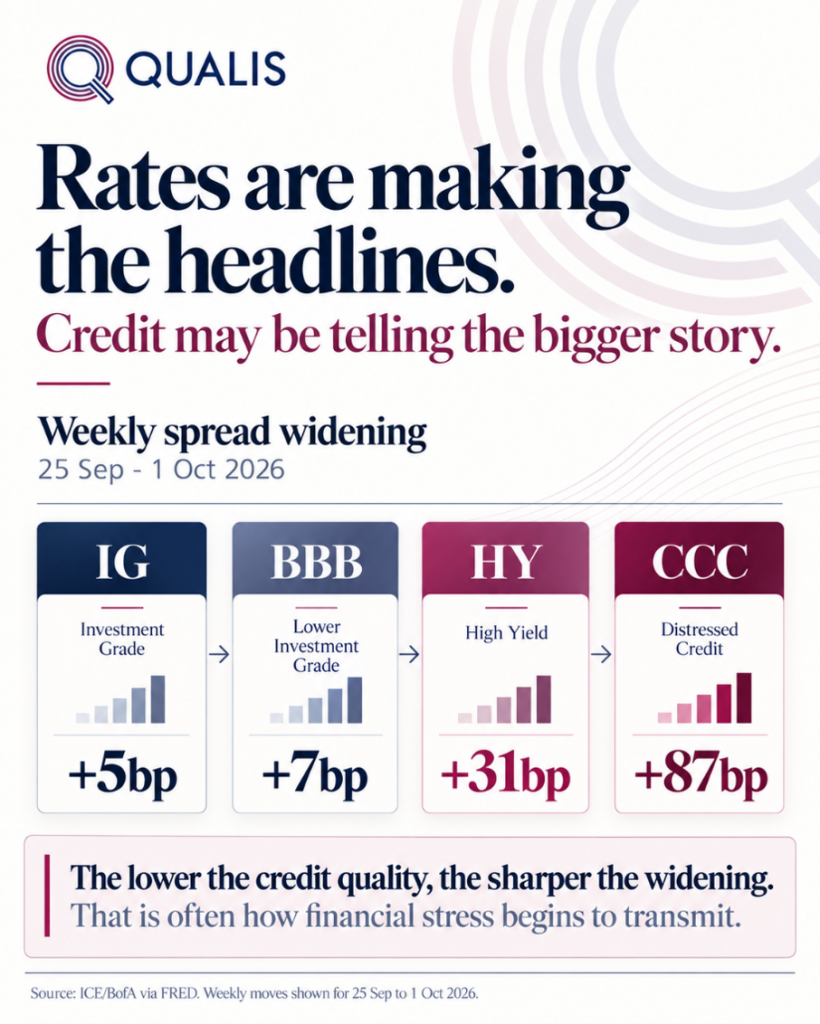
That is not random. It is the market becoming more discriminating as the quality of the borrower falls. In other words, investors are not yet treating all corporate credit the same. They are demanding progressively more compensation as balance-sheet risk increases.
That is exactly the kind of pattern you would expect to see if higher sovereign yields are beginning to filter into broader financial conditions.
Importantly, this still does not amount to a full-blown credit event. Investment-grade spreads remain a long way from crisis territory. But the direction, speed and quality split all matter.
When the weakest parts of the market begin to widen first, it is often the earliest sign that something more meaningful may be developing underneath the surface.
Europe may be the clearer warning signal
In some respects, Europe is now giving the sharper signal. The French 10-year spread over Germany has widened materially, briefly approaching levels that are difficult to dismiss as simple day-to-day market noise. At the same time, European credit indicators such as crossover CDS have also moved wider.
That combination is important.
A sovereign issue on its own can remain contained for some time. But when sovereign stress begins to coincide with wider corporate credit spreads and more obvious concern around funding conditions, the read-across becomes more serious.
That does not mean we are in a systemic credit crisis. But it does suggest that this is no longer just a story about bond-market volatility.
Why this matters for investors
For much of this year, markets have been able to absorb higher yields relatively well. Equities have often looked through the move, and credit has been more resilient than many might have expected. The question now is whether that resilience is starting to fade.
If government bond yields remain elevated, or continue rising, companies are faced with a more expensive funding backdrop. For stronger borrowers, that may be manageable. For weaker borrowers, it becomes much more significant. The result is that spreads begin to widen, and financing conditions tighten in a more meaningful way.
That is why we think the real story is shifting.
The headlines are still on rates. But credit may increasingly become the transmission mechanism through which higher yields affect the rest of the market.
What we are watching now
The sequence we are focused on is straightforward:
Sovereign stress -> weaker credit -> mainstream corporate credit -> equities
We have already seen the first stage. We are now seeing clearer evidence of the second. The next question is whether this deterioration remains confined to the weakest areas of credit, or whether it migrates further into mainstream corporate borrowing conditions. If it does, the implications for broader risk assets become more meaningful.
For now, I do not think the evidence supports a dramatic “credit is falling over” conclusion.
But I do think it supports a more measured and important point: something has changed.
Rates are no longer just an isolated bond-market story. Credit is beginning to respond, and history suggests investors should pay attention when that happens.
In short, rates are making the headlines.
But credit may be telling the bigger story.
This article is for information only and does not constitute investment advice or a personal recommendation. Capital is at risk, and the value of investments can fall as well as rise.