A Market Recovery Can Arrive Before Confidence Returns
2 November 2026
Why waiting for reassurance can mean missing the early stages of a recovery
There is a temptation, after a difficult period in markets, to wait until the outlook feels clearer. Let the headlines improve. Let the uncertainty pass. Then consider the opportunities.
I understand that instinct. The difficulty is that share prices do not wait for us to feel comfortable. A recovery can begin while the news is still unsettling, because investors start to see a future that is less difficult than the one already reflected in prices.
That is why I believe there is room for a constructive discussion today. We do not need to assume that the correction is over to ask whether pessimism is creating opportunities worth investigating.
Better than feared can be enough
Markets respond to the difference between expectations and outcomes. A company priced for a sharp deterioration can recover on a merely resilient result. More broadly, oil need not become cheap and every economic indicator need not improve at once. A stabilising outlook can matter when investors have been preparing for something worse.
Earnings provide a useful foundation. FactSet put blended S&P 500 third-quarter earnings growth at 30.2% on 30 October, with around 60% of companies having reported. However, aggregate earnings exceeded estimates by only 1.9%, below the five-year average of 7.5%. Profits are resilient; the strength of the surprise deserves qualification.
Look beyond the headline valuation
Yardeni Research’s chart of the S&P 500’s aggregate and median forward valuations adds another perspective. Its September median reading was 16.6 times expected earnings. The median describes the middle company in the distribution, rather than the index’s aggregate valuation, and helps us look beyond the influence of its largest constituents.
The long history shows valuations retreating from recent highs, although they remain above levels seen in many earlier periods. That supports a selective opportunity argument. It does not establish that the whole market is exceptionally cheap. Expected earnings can fall, and higher interest rates can justify a lower price for them.
When positioning matters as well as profits
Share prices also respond to investors changing the amount of risk they carry. A leveraged investor facing losses may reduce positions even when the long-term case for a business remains intact. Such selling can amplify a decline beyond the initial change in expectations.
There is evidence that investors entered October cautiously. In a discussion recorded on 7 October, Goldman Sachs described historically low net equity exposure among its fundamental long-short hedge-fund clients. This is a dated snapshot of a particular investor group, rather than a measure of all investors or proof that selling has finished.
The constructive possibility is that, if selling pressure eases while profits hold up, prices may stabilise before confidence visibly improves. Reduced positioning alone cannot make that happen. Investors cutting both long and short positions may also be buying back shorts; lower gross exposure does not automatically mean a wave of future equity buying.
History offers perspective
The approaching US midterm elections provide useful historical context. MUFG’s 28 October research presents individual one-year S&P 500 returns following past midterms, with an average of around 15%. The range of outcomes matters more than an average presented in isolation.
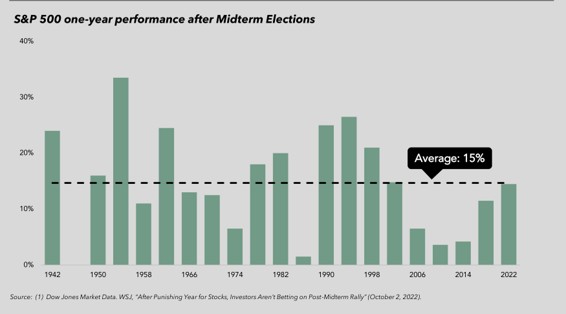
Source: MUFG, Equities Pre & Post Midterm Elections, 28 October 2026; underlying credit to Dow Jones Market Data and WSJ retained in the chart. Historical one-year US index returns, not GBP fund returns or a forecast for the remainder of Q4. Past performance is not a reliable indicator of future results.
The pattern is encouraging, but elections do not operate independently of earnings, inflation or interest rates. These are completed full-year periods, with different economic backdrops. They cannot identify this market’s low or establish what November will deliver. I take the history as a reason to keep an open mind when uncertainty feels overwhelming.
Preparing before confidence returns
I would look for earnings expectations holding up, more companies participating in market strength and credit conditions stabilising. Easing energy pressures would also help. A recovery supported by those developments would be more persuasive than a short bounce in a handful of shares.
Weaker cash generation, falling earnings forecasts or worsening credit stress would challenge the constructive case. Being somewhat contrarian means testing whether pessimism has gone too far, while remaining willing to change our assessment.
For us at Qualis, this favours diversification and selective adjustments as conviction develops. Opportunities could extend beyond the companies that led the previous advance. We can prepare by understanding what we own, what we would like to own and what evidence would justify a change.
The next sustained recovery may begin before the headlines become reassuring. Confidence may follow rising prices. The investment work needs to begin earlier.
This article is for information only and does not constitute investment advice or a personal recommendation. Capital is at risk, and the value of investments can fall as well as rise.