The Headlines Are Grim. The Evidence Is Not.
26 October 2026
Why a difficult world may still offer investors more reasons for optimism than the headlines suggest.
Turn on the news and there is little to encourage optimism. Conflict, energy disruption, persistent inflation and stretched government finances dominate the conversation. Markets have added their own concerns: higher borrowing costs, nervous investors and uncomfortable questions about the price of artificial intelligence.
None of these problems is imaginary. But there is a danger in allowing the catalogue of what might go wrong to obscure what is still going right.
Across the world, businesses continue to grow, investment continues to be committed and industries are adapting to challenges that, only a few years ago, seemed unlikely. The picture is complicated. It is not uniformly bleak.
Companies are doing rather more than the headlines suggest
The most persuasive reason to retain a constructive view of equities is not an election-year pattern or a contrarian sentiment indicator. It is corporate profitability.
FactSet’s 23 October analysis puts blended third-quarter S&P 500 earnings growth at 29.5% year on year. Of the companies to have reported, 83% exceeded analysts’ earnings-per-share expectations. Ten of the eleven sectors were showing earnings growth.
There is an important qualification: only 24% of index companies had reported, and the average size of earnings surprises was smaller than usual. The final outcome may change. Nonetheless, these are not the numbers of a corporate sector that has collectively stopped making progress.
A correction in valuation, not necessarily in profitability
Something else has been changing quietly beneath the headlines: investors are paying less for expected corporate earnings. Yardeni Research reports that the S&P 500’s forward price-to-earnings ratio stood around 18.4 times on 23 October, down from a previous peak of about 23.2 times. Technology has experienced an even larger repricing from its end-2025 multiple.
The more striking observation is what has happened this year. Yardeni reports that forward earnings rose approximately 31% while the S&P 500 price index gained 11.4%. Using those matched growth figures implies around a 15% contraction in the valuation multiple. In other words, expected earnings have been growing substantially faster than the prices investors pay for them.
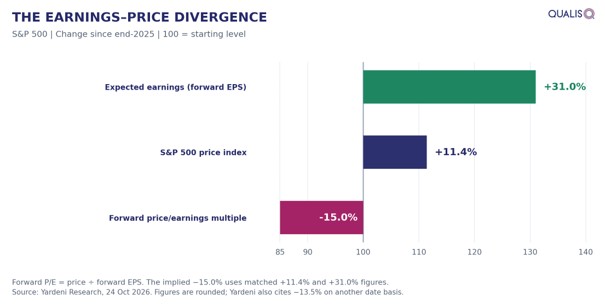
Figure 1. The earnings–price divergence. Source: Yardeni Research (24 October 2026); Qualis calculation from published rounded rates.
That is encouraging, but not a guarantee. The rolling forward-earnings measure can rise partly as its forecast window advances into a later year; analysts must still deliver on their forecasts. Higher bond yields and funding costs can also justify lower equity multiples. Even allowing for those caveats, the combination of rising earnings and a less demanding price is distinctly different from a market where profits and prices are collapsing together.
The contrast with sentiment is striking
The AAII survey for the week ending 21 October found 45.8% of individual investors bearish, well above its historical average of 31.5%. It is understandable that confidence has been shaken. Yet pessimism in the survey sits alongside substantial reported and expected earnings growth.
These are different measures and neither determines what markets will do next. What they illustrate is that investors’ mood and businesses’ results do not always tell the same story at the same time.
Last week I wrote about the importance of making investment decisions from the evidence in front of us, rather than defending opinions formed previously. That principle applies just as much when evidence offers reasons for encouragement as when it warns us to be cautious.
The wider world has not stopped growing
The opportunities are not confined to Wall Street, or indeed to artificial intelligence. The International Monetary Fund’s October outlook forecasts global growth of 3.1% in 2026 and 3.4% in 2027. The OECD is more restrained, but it too expects the world economy to expand despite formidable challenges.
Nor is the valuation story confined to the United States. In MSCI’s comparable 30 September data, European equities traded on approximately 14.2 times forward earnings, Japan on 15.6 times and emerging markets on 9.7 times, compared with 19.4 times in the US. The differences partly reflect sector composition, economic and currency risk, and the reliability of forecasts. Cheaper does not automatically mean better. But it demonstrates why the global investment opportunity cannot be reduced to a single US index.
Asia remains important to that broader picture, with significant differences between countries and industries. Growth in an economy does not guarantee attractive share-price returns; valuations and governance matter. Nonetheless, economic and commercial progress is taking place across regions.
Look at where the world is still investing
If the headlines suggest the world is standing still, capital spending tells a different story. The International Energy Agency expects global energy investment to reach a record $3.4 trillion in 2026. Electricity-grid investment alone is forecast to approach $550 billion, nearly 20% higher than a year earlier.
That is not all about AI. It includes energy security, electricity networks, generation, storage and the practical task of making economies more resilient. It creates activity for engineering businesses, equipment suppliers, industrial companies and infrastructure providers across the world.
There is continued investment within technology, too. ASML reported €11.7 billion of quarterly sales and said customers were considering equipment orders extending well into the next decade. The economics of AI projects still need to be tested, but investment demand has not simply disappeared.
And even the market itself may be changing
During the week ending 23 October, the S&P 500 declined even though approximately two-thirds of its constituents rose, according to MarketWatch. Eight of the eleven sectors advanced. That does not establish a durable new trend, but it suggests the headline index may be concealing broader participation.
If that broadening persists, more businesses and sectors may contribute to returns. For diversified investors, the next stage need not depend entirely on the same handful of technology companies that dominated the last.
Optimism does not require an all-clear
The risks remain real. Elevated energy prices, restrictive interest rates and signs of stress in lower-quality credit could all undermine the outlook. Earnings forecasts may prove too ambitious and valuations may contract further.
But caution and pessimism are not the same thing. It is possible to acknowledge those risks while recognising that companies are growing, technology is advancing, investment is being committed and the range of opportunities may be broadening.
Markets rarely present investors with a completely reassuring set of headlines. The important question is whether businesses can continue to adapt, invest and create value in the world as it is.
Today’s evidence suggests many of them can.
The world has no shortage of difficulties. Thankfully, it has no shortage of ingenuity either.
And perhaps, amid so much negativity, that deserves a little more attention.
Investment values can fall as well as rise. This material is for information only and is not investment advice or a personal recommendation.
Research appendix | Sources and valuation comparisons
Prepared 25 October 2026. Observations are date-stamped. The charts are original Qualis illustrations derived from attributed data, not reproduced proprietary Yardeni graphics.
Comparable regional valuation snapshot
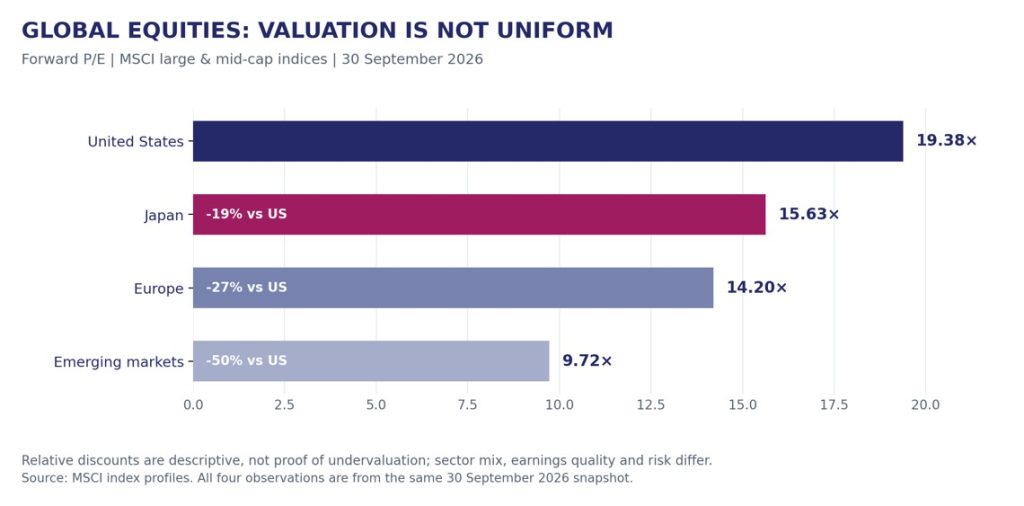
Figure 2. MSCI forward P/E multiples as of 30 September 2026. These are not updated for October price movements.
Calculation and methodology
- Identity: price = forward EPS × forward P/E. Taking published rounded YTD figures, (1 + 11.4%) ÷ (1 + 31.0%) − 1 = −15.0% implied multiple change. Yardeni also reports −13.5%; the two figures are not strictly reconciled and should not be presented as identical.
- Peak-to-current 23.2× → 18.4× represents −20.7%, but the starting peak date differs from the year-to-date decomposition.
- Forward EPS is a rolling estimate that may rise through calendar roll-forward; fixed-fiscal-year analyst estimate revisions should be monitored separately.
- MSCI September multiples use the same benchmark provider and observation month. Regional valuation discounts are not returns forecasts and may be explained partly by sector mix, capital intensity, currency, governance and earnings-risk differences.
- FactSet’s forward P/E of 18.7× on 23 October differs from Yardeni’s 18.4×: methodological and consensus-data differences, not a correction to be concealed.
This article is for information only and does not constitute investment advice or a personal recommendation. Capital is at risk, and the value of investments can fall as well as rise.
Primary sources
Yardeni Research, 24 October 2026 — https://yardeni.com/research/quicktakes/2026/10/24/us-markets-call-still-proceeding-cautiously
FactSet Earnings Insight, 23 October 2026 — https://insight.factset.com/sp-500-earnings-season-update-october-23-2026
MSCI USA, 30 September 2026 — https://www.msci.com/indexes/index/984000/msci-usa-index
MSCI Europe, 30 September 2026 — https://www.msci.com/indexes/index/990500/msci-europe-index
MSCI Japan, 30 September 2026 — https://www.msci.com/indexes/index/939200/msci-japan-index
MSCI Emerging Markets, 30 September 2026 — https://www.msci.com/indexes/index/891800/msci-em-emerging-markets-index-2
AAII Sentiment Survey, 21 October 2026 — https://www.aaii.com/sentiment-survey
IMF, October 2026 World Economic Outlook — https://www.imf.org/en/Publications/WEO/Issues/2026/10/13/world-economic-outlook-october-2026
IEA World Energy Investment 2026 — https://www.iea.org/reports/world-energy-investment-2026
ASML Q3 2026 results, 14 October — https://www.investor.asml.com/news-releases/news-release-details/asml-reports-eu11.7-billion-total-net-sales-and-eu5.0-billion-net-income-q3-2026
Original Qualis sentiment article — https://qualisfunds.co.uk/insight/when-being-right-becomes-more-important-than-making-money/